Blog
On the assassinations of US presidents

In the midst of the shock and revulsion at the recent shooting of former president Donald J. Trump by Thomas Matthew Crooks, it is important to remember that assassinations, and attempted assassinations, are relatively common in the United States. Four US presidents have been killed by assassins while in office, and there have been numerous assassination attempts. The earliest attempt on the life of a US president was the attack on President Andrew Jackson by English-American house-painter Richard Lawrence in January 1835. Lawrence shot Jackson outside the US Capitol; he fired two pistols, both of which misfired. Lawrence was subsequently tried, and found not guilty by reason of insanity; he spent the remainder of his life at various insane asylums. Jackson was unharmed in the attack, dying of natural causes in 1845.
Many people could probably name two of the American presidents who were killed in office, but the other two are less well known. Abraham Lincoln was shot by John Wilkes Booth, a stage actor, while Lincoln was attending Ford’s Theatre in Washington, DC, on 14 April 1865. Lincoln died of his injury the following day. Booth, a Confederate sympathiser, had originally plotted with a small group of conspirators to kidnap Lincoln. Booth fled the scene and eventually took shelter in a barn on a tobacco farm in Virginia. The barn was subsequently set on fire in an attempt to end the siege, and Booth was shot dead by Sergeant Thomas H. ‘Boston’ Corbett in the ensuing shootout.
John F. Kennedy was assassinated by former US Marine Lee Harvey Oswald while riding in a presidential motorcade through Dealey Plaza, Texas, on 22 November 1963. Oswald shot Kennedy from the nearby Texas School Book Depository. Two days later, Oswald was himself shot dead by local nightclub owner Jack Ruby in the basement of the Dallas Police Headquarters. Although Oswald claimed to have been a ‘patsy’, the Warren Commission concluded in September 1964 that Oswald had acted alone. Coincidentally, Oswald’s father was a third cousin of President Theodore ‘Teddy’ Roosevelt.
William McKinley was killed by Leon Czolgosz, an American labourer and anarchist, in September 1901 in Buffalo, New York. McKinley died a little over a week after the attack, as a result his wound becoming infected. Czolgosz was tried, convicted of the crime and executed in October 1901.
Charles J. Guiteau assassinated James A. Garfield in 1881. Guiteau (wrongly) believed he had played a major role in Garfield’s election victory, and felt that he should have been rewarded with a consulship (the modern-day equivalent of an ambassadorship). When his efforts to secure a post were rejected, he shot Garfield at the Baltimore and Potomac Railroad Station in Washington, DC, on 2 July. Garfield died two months later from infections related to the wounds he had sustained in the attack. Guiteau was sentenced to death in January 1882 and was executed by hanging in June that year.
More recently, Ronald Reagan was shot by John Hinckley Jr outside the Hilton Hotel in Washington, DC, in March 1981. Hinckley was reportedly seeking notoriety in order to impress actress Jodie Foster, with whom he had become fixated after watching her in the 1976 film Taxi Driver, directed by Martin Scorsese. Reagan recovered quickly from the gunshot wound, and completed his term as president, being reelected for a second term in 1984. Professor J. David Woodard says that the assassination attempt ‘created a bond between [Reagan] and the American people that was never really broken’; Reagan himself came to believe that God had spared his life ‘for a chosen mission’.
In a recent interview, Donald Trump Jr revealed that his father was ‘full of resolve and joking’ about being shot, just hours after the attack. The assassination attempt is likely to have a significant impact on the forthcoming US presidential elections.
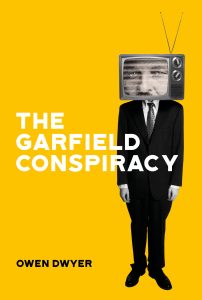
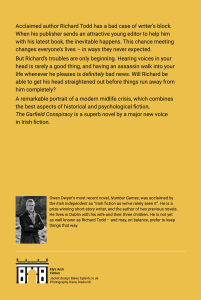
In the novel THE GARFIELD CONSPIRACY, author Owen Dwyer uses the assassination of James Garfield as the historical background for an examination of psychological breakdown. The book, which has been warmly reviewed, is a remarkable, disturbing portrait of a middle-aged man torn between his carefully constructed life and new adventures which may beckon, in the present and the past. Owen is also the author of sci-fi thriller NUMBER GAMES – which was described by Darragh McManus, writing in the Irish Independent, as ‘Irish fiction as we’ve rarely seen it’.