


Blog
Sorry for Your Trouble

Richard Ford is arguably our finest living short-story writer. His latest collection, Sorry for Your Trouble, released in 2022, contains a welcome surprise for Dublin readers: all the stories have an Irish theme – in terms of characters or setting, or both – and many are set in the capital, with great attention to detail*.
A somewhat tacky industry has grown up around the idea that the Irish are natural storytellers, but at the heart of it is a kernel of truth. In his epic poem Paterson, William Carlos Williams referenced “Carmody, an Irish woman who could tell a story when she’d a bit taken.” Ford, who has taught creative writing at Trinity College Dublin for many years and obviously has a great grá for the place, no doubt appreciates that Ireland may be one of the wellsprings of the form.
Ford is an interesting, at times elusive writer. In an interview to promote the release of his collection Women With Men back in 1997, he was asked whether the title was a play on Ernest Hemingway’s Men Without Women. He said it was not – but we know better. A writer worth their salt needs to protect their sources. Ford marks a move from Hemingway’s macho style to a more inclusive one, in which women play a full, perhaps leading, part in the situation. The shift is important – a points a new way forward for the art.
Another Ford collection, Wildlife, has been turned into a film – the ultimate accolade, perhaps. It’s on my list. (Bracket it with Winter’s Bone by Daniel Woodrell – a writer with whom Ford shares a dirty-realist aesthetic.)
I recently overheard someone urging fellow rugby fans to see Johnny Sexton playing at Donnybrook before he retired – because he was one of the best fly-halves ever to have pulled on an Ireland rugby shirt, and was about to retire. I feel the same way about Ford. Sorry for Your Trouble is a superb, nuanced piece of work – a late flowering by a rare talent, hard won. We should read it – and continue to celebrate Ford – while he’s still with us.

* I bought my copy secondhand, priced €9. In good old-school-bookseller style, the price was given as “9”, in pencil in the flyleaf. Many writers – James Joyce being one –had a great interest in numerology, believing numbers to have semi-mystical powers. And why not? After all, while nine chairs exist (as far as we can tell), the number nine does not. At least, you can’t put your finger on it.
My father once almost bought a house mainly on the strength of its address: 16 The Square. As he noted, not only is 16 a square, it is a perfect square: a square of a square.
It is said that the Bloomsbury set lived in squares and loved in triangles. My copy of Sorry for Your Trouble was marked with a number that is a square of a triangle, as it were (i.e. three squared). Perhaps Virginia Woolf would have approved.
For more in this vein, I recommend Once Upon a Prime by Sarah Hart – the first woman to be named Gresham Professor of Geometry in Gresham College, arguably the oldest chair in mathematics in Britain, established in 1597. They got there eventually!
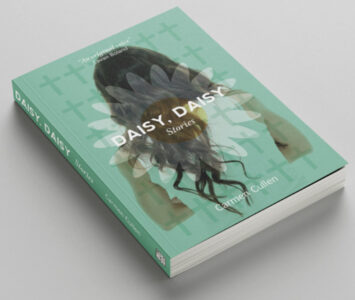
Seán O’Keeffe is the publisher at Liberties Press. Daisy, Daisy by Carmen Cullen will be launched at the Mermaid Arts Centre in Bray on Thursday 26 September. The book is published by Ely’s Arch Books, an imprint of Liberties Press. Carmen is a former student of Ford – having attended the MPhil in English Literature at Trinity College Dublin in 2009. Book your place at the launch here